The question, from a backbencher: "Should political scientists learn political theory?"
The answer: I retract my previous equivocations on the subject and affirm that they should, unreservedly.
Like Evelyn Waugh's Mr. Salter, though, I will caveat my policy by saying that political scientists need to know political theory up to a point.
There is no contradiction between these two statements, even though superficially they are plainly opposed. Rather, what I mean to suggest is that the role of political theory in the training of empirical political scientists needs to become something more like the role of methodologists in the training of the same. Just as we expect researchers to know enough about methods to be competent in their field, so too should we demand that they have reflected sufficiently about the normative implications of their work and of the real-world debates into which their work may enter.
This is an unabashedly utilitarian view of theory. Many theorists might object that this, then, devalues their work. After all, shouldn't it stand on its own? Isn't political theory a field in its own right, with its own claims, and with its own research? The answer to all of these questions is very much yes, but that is beside the point. I am not adjudicating what the role of political theory in the discipline should be, nor attempting to regulate its external affairs. After all, the same questions could be posed of methods research, and I would respond in the same way in that case. The distinction I am drawing is not one that demeans theory (or methods) but which merely underscores what is obviously true: that political science research is conducted by people who have scarce time and limited interest in debating the good, the just, and the true. If they had greater interest in discussing those topics, then they would be political theorists themselves.
Yet my analogy is exact. In the same way as we believe that methods training is an essential part of bringing up scholars to adhere to community standards and to producing reliable research, we should similarly believe that engagement with theory has the virtue of warning off scholars from making claims about their work, or assumptions within their models, that are either laughably wrong or dangerously naive. This is, consequently, a strong affirmation of the value of theory training, albeit one that is studiously agnostic about which of the different camps of theory should be employed. I leave that to the theorists, such as Mr. Williams.
With one exception. Such courses cannot linger too long on the ancients. I once described my university's required theory course as covering the sweep of theory from Plato to Aristotle. That was an exaggeration, as others promptly reminded me: The course also covered Augustine. Actually, teach Plato and Aristotle, and teach Augustine and Machiavalli too; teach Hobbes and Locke, but teach them better than they are normally treated; but mostly, treat people whose principal concerns were those relevant to the work of contemporary political science. Thinkers who deal with the nature of the state in its modern form (and the polis is not, in the end, a modern state), who deal with the questions of justice both within and among political communities, who deal with the questions of nationalism, and who deal with the nature of questions of personhood (of identity, of gender, and of race) are vastly more relevant to empirical social scientists than exegeses. That's a lot to cover in a semester, but better to serve up tapas that might be nibbled than an entree that will be left uneaten.


11 May 2011
Is "Starve the Beast" Conservatism on Its Last Legs?
The question: The Honorable Mr. Williams asks, "Is the coming debt ceiling fight the watershed moment for this strategy? Put another way, is this the culmination of Starve the Beast?"
The answer: No.
The Honorable Mr. Williams is a good man of sound judgment and public spirit, and so he believes that all men are like himself. But everyday politics has never been a game played only by the public-spirited, which is why Cincinnatus and the Duke of Zhou are remembered. Were their virtue normal, and not exceptional, we would have no need to remember their names. In essence, he proceeds from the false assumption that "starve the beast" means (a) starving the beast and (b) that it is possible to sate elite activists' demands.
Sometime around 1975, American politics irrevocably changed. The confluence of post-Roe, anti-ERA, and pro-Reagan mobilization created a new, self-consciously unified conservative elite which has dominated GOP politics for nearly 40 years and whose generational reproduction seems assured. (Eric Cantor was not there with Phyllis Schafly, but he is no different from the hungry young men who took part in killing ERA.) Among Democrats, the fracturing of the New Deal coalition healed, as it had to but the elite consensus that guided the Democratic Party and left politics has never recovered. It is telling that the Democratic Party features a far richer diversity of intramural debate than the Republican Party; the liberal movement inhabits dozens of "little magazines" where the intellectual Marines of an even larger number of factions contend.
The conservative movement is not monolithic, but its distribution of opinion has far less variance than its liberal counterpart. And Republicans have consistently shown a vastly greater ability to mobilize resources, direct policy, and maintain caucus discipline than Democrats--even when those goals are fundamentally not conservative. (Think, for instance, of the brutal whipping the leadership applied on Medicare Part D, which was more hated at the time among conservatives than the Iraq War. I know, because at the time I was writing for a conservative blog and that is what we all agreed.)
"Starve the beast" was never a strategy for the anti-tax, pro-military, and de-regulation faction that has been largely predominant in Republican circles since Ford fired Rockefeller. it was, instead, a slogan, rather like the Leninist "peace, land, bread" slogan that excused the practical surrender of Russian lands. The "beast" that was to be starved has, in fact, never been touched; Republicans are quite happy to put it on reduced rations by maintaining policy drift while giving the top 1% (and the top 0.1%, and the top 0.01%) of households by income generous tax breaks. Think not "starve the beast"--rather, think "feed the rich."
The acid test of whether Republican elites are more interested in serving what we used to call the moneyed interests lies in examining carefully legislative initiatives like Medicare Part D or the Walker plan for Wisconsin. These are not first-order priorities for conservatism. Indeed, it is difficult to deduce how most of these initiatives flow from the sincerely expressed ideals that philosophical conservatives embrace. But it is very easy to deduce how they serve the interests of key Republican constituencies. As those constituencies rack up the score in the Congress and in state houses across the country, it is difficult to see why they would ever relent.
Lombardi was wrong about football, but right about politics, when he said that winning wasn't everything--it was the only thing. And so too in politics. Government is for keeps, and there should be no unilateral disarmament. (One thing that I have never understood is the mentality prevalent among self-identified progressives that holds that compromise is a good thing of itself. It is one thing to take half a loaf; it is another to take half a loaf simply because someone has asserted, with no justification, that he deserves half of your whole loaf.)
The debt ceiling will be raised; it will be raised at the last possible moment; it will be raised at great cost to the poor and the Democratic. In this, Boehner is simply responding both to the structural pressures on him within his caucus but also to the fact that to do otherwise would be to miss an opportunity to press what are, I'm sure, his sincere policy preferences. And why should he do so? It is not "statesmanlike" to forbear from using your advantage in such a situation; it is merely weak. And so the "starve the beast" strategy will, apparently, fail, but it will have actually succeeded, because any concessions that he will have wrung out of the White House on this will be a net gain for his party.
The answer: No.
The Honorable Mr. Williams is a good man of sound judgment and public spirit, and so he believes that all men are like himself. But everyday politics has never been a game played only by the public-spirited, which is why Cincinnatus and the Duke of Zhou are remembered. Were their virtue normal, and not exceptional, we would have no need to remember their names. In essence, he proceeds from the false assumption that "starve the beast" means (a) starving the beast and (b) that it is possible to sate elite activists' demands.
Sometime around 1975, American politics irrevocably changed. The confluence of post-Roe, anti-ERA, and pro-Reagan mobilization created a new, self-consciously unified conservative elite which has dominated GOP politics for nearly 40 years and whose generational reproduction seems assured. (Eric Cantor was not there with Phyllis Schafly, but he is no different from the hungry young men who took part in killing ERA.) Among Democrats, the fracturing of the New Deal coalition healed, as it had to but the elite consensus that guided the Democratic Party and left politics has never recovered. It is telling that the Democratic Party features a far richer diversity of intramural debate than the Republican Party; the liberal movement inhabits dozens of "little magazines" where the intellectual Marines of an even larger number of factions contend.
The conservative movement is not monolithic, but its distribution of opinion has far less variance than its liberal counterpart. And Republicans have consistently shown a vastly greater ability to mobilize resources, direct policy, and maintain caucus discipline than Democrats--even when those goals are fundamentally not conservative. (Think, for instance, of the brutal whipping the leadership applied on Medicare Part D, which was more hated at the time among conservatives than the Iraq War. I know, because at the time I was writing for a conservative blog and that is what we all agreed.)
"Starve the beast" was never a strategy for the anti-tax, pro-military, and de-regulation faction that has been largely predominant in Republican circles since Ford fired Rockefeller. it was, instead, a slogan, rather like the Leninist "peace, land, bread" slogan that excused the practical surrender of Russian lands. The "beast" that was to be starved has, in fact, never been touched; Republicans are quite happy to put it on reduced rations by maintaining policy drift while giving the top 1% (and the top 0.1%, and the top 0.01%) of households by income generous tax breaks. Think not "starve the beast"--rather, think "feed the rich."
The acid test of whether Republican elites are more interested in serving what we used to call the moneyed interests lies in examining carefully legislative initiatives like Medicare Part D or the Walker plan for Wisconsin. These are not first-order priorities for conservatism. Indeed, it is difficult to deduce how most of these initiatives flow from the sincerely expressed ideals that philosophical conservatives embrace. But it is very easy to deduce how they serve the interests of key Republican constituencies. As those constituencies rack up the score in the Congress and in state houses across the country, it is difficult to see why they would ever relent.
Lombardi was wrong about football, but right about politics, when he said that winning wasn't everything--it was the only thing. And so too in politics. Government is for keeps, and there should be no unilateral disarmament. (One thing that I have never understood is the mentality prevalent among self-identified progressives that holds that compromise is a good thing of itself. It is one thing to take half a loaf; it is another to take half a loaf simply because someone has asserted, with no justification, that he deserves half of your whole loaf.)
The debt ceiling will be raised; it will be raised at the last possible moment; it will be raised at great cost to the poor and the Democratic. In this, Boehner is simply responding both to the structural pressures on him within his caucus but also to the fact that to do otherwise would be to miss an opportunity to press what are, I'm sure, his sincere policy preferences. And why should he do so? It is not "statesmanlike" to forbear from using your advantage in such a situation; it is merely weak. And so the "starve the beast" strategy will, apparently, fail, but it will have actually succeeded, because any concessions that he will have wrung out of the White House on this will be a net gain for his party.
10 May 2011
Why does automation threaten the viability of qualitative research?
The question, from a backbencher: "How are quallys different from quantoids?"
The answer: Few topics are so perennially interesting for the individual political scientist and the discipline as the Question of Method. This is normally, quickly, and violently reduced to the Quant v. Qual debate, which is a battle of those who can't count against those who can't read. Even divisions that really affect other dimensions of methodological debate, such as those that separate formal theorists and interpretivists from case-study researchers and econometricians, are lumped into this artificial dichotomy. Formal guys know math, so they must be econometricians, or at least close enough; interpretivists use language, ergo they are case-study guys, or at least close enough. And so elective affinities are reified into camps, among which ambitious scholars must choose. (How else to understand EITM, which is the worst bastardization of all: the melding of deterministic theory with stochastic modeling?)
(Incidentally, let's not delude ourselves into thinking that mutli-method work is a via media. In everyday practice, quantoids proceed according to a one-drop rule: if a paper contains even the slightest taint of process-tracing or case studies, then it is irremediably quallish. In this, then, those of us who identify principally as multi-method guys stand in relation to the qual-quant divide rather as Third Way folks stand in relation to left-liberals and to all those right of center. That is, the qualitative folks reject us as insufficiently pure, while the quant camp thinks that we are all squishes.)
There is one point, however, in which it is incontestable that the quantoids have the upper hand on everyone else. And that is in the ease of transmission of the techne of data management, of data collection, and the analysis of data. I do not mean the high-concept stuff. All of that is usually about as difficult and as rarefied as the qualitative or formal high-concept readings, and about as equally useful to the completion of an actual research project--which is to say, not very, except insofar as it is beaten into everyday practice. (That R^2 continues to be reported as an independently meaningful statistic even 25 years after King (1986) is shocking, but the Kuhnian generational replacement has not yet so far really begun to weed out such ideological deviationists.)
No, when I talk about techne, I mean something closer to the quotidian translation of the replication movement, which when put into practice is rather like the business consultant notion of "best practices." There is a real craft to learning how to manage data, and how to write code, and how to present results, and so forth, and all of this is completely independent of the project on which a researcher is engaged. Indeed, it is perfectly plausible that I could take most of the thousands of lines of data-cleaning and analysis code that I've written in the past month for the GSS and the Jennings-Niemi Youth-Parent Socialization Survey, tweak four or five percent of the code to reflect a different DV, and essentially have a new project, ready to go. (Not that it would be a good project, mind you, but going from GRASS to HOMOSEX would not be a big jump.)
There is nothing quite like that for qualitative guys. Game theory folks come close, since you can tweak models indefinitely, but of course they then have to find data against which to test their theories (or not, as the case may be). Neither intepretivists nor case-study folks, however, can automate the production of knowledge to the same extent that quant guys can. And neither of those approaches appear to be as easily taught as quant approaches. The sage of Cambridge (that is to say, Gary Rex) is uncharacteristically almost snide in a passage from an unpublished paper:
Brad DeLong put the problem plainly in his obituary of J.K. Galbraith:
This is among the reasons I think that the Qual v Quant battle is being fought on terms that are often poorly chosen, both from the point of view of the qualitative researcher and also from the discipline. Quant researchers will simply be more productive than quant guys, and that differential will continue to widen. (This is a matter of differential rates of growth; qual guys are surely more productive now than they were, and their productivity growth will accelerate as they adopt more computer-driven workflows, as well. But there is no comparison between the way in which computing power increases have affected quallys and the way they have made it possible for even a Dummkopf like me to fit a practically infinite number of logit models in a day.) This makes revisions easier, by the way: a quant guy with domesticated datasets can redo a project in a day (unless his datasets are huge) but the qual guy will have to spend that much time pulling books off the shelves.
The qual-quant battles are fought over the desirability of the balance between the two fields. And yet the more important point has to do with the viability, or perhaps the "sustainability," of qualitative work in a world in which we might reasonably expect quant guys to generate three to five times as many papers in a given year as a qual guy. Over time, we should expect this to lead to first a gradual erosion of quallies' population, followed by a sudden collapse.
I want to make plain that I think this would be a bad thing for political science. The point of the DeLong obituary is that a discipline without Galbraiths is a poorer one, and I think the Galbraiths who have some methods training would be much better than those who simply mastered lots and lots of facts. But a naive interpretation of productivity ratios by university administrators and funding agencies will inevitably lead to qualitative work's extinction within political science.
The answer: Few topics are so perennially interesting for the individual political scientist and the discipline as the Question of Method. This is normally, quickly, and violently reduced to the Quant v. Qual debate, which is a battle of those who can't count against those who can't read. Even divisions that really affect other dimensions of methodological debate, such as those that separate formal theorists and interpretivists from case-study researchers and econometricians, are lumped into this artificial dichotomy. Formal guys know math, so they must be econometricians, or at least close enough; interpretivists use language, ergo they are case-study guys, or at least close enough. And so elective affinities are reified into camps, among which ambitious scholars must choose. (How else to understand EITM, which is the worst bastardization of all: the melding of deterministic theory with stochastic modeling?)
(Incidentally, let's not delude ourselves into thinking that mutli-method work is a via media. In everyday practice, quantoids proceed according to a one-drop rule: if a paper contains even the slightest taint of process-tracing or case studies, then it is irremediably quallish. In this, then, those of us who identify principally as multi-method guys stand in relation to the qual-quant divide rather as Third Way folks stand in relation to left-liberals and to all those right of center. That is, the qualitative folks reject us as insufficiently pure, while the quant camp thinks that we are all squishes.)
There is one point, however, in which it is incontestable that the quantoids have the upper hand on everyone else. And that is in the ease of transmission of the techne of data management, of data collection, and the analysis of data. I do not mean the high-concept stuff. All of that is usually about as difficult and as rarefied as the qualitative or formal high-concept readings, and about as equally useful to the completion of an actual research project--which is to say, not very, except insofar as it is beaten into everyday practice. (That R^2 continues to be reported as an independently meaningful statistic even 25 years after King (1986) is shocking, but the Kuhnian generational replacement has not yet so far really begun to weed out such ideological deviationists.)
No, when I talk about techne, I mean something closer to the quotidian translation of the replication movement, which when put into practice is rather like the business consultant notion of "best practices." There is a real craft to learning how to manage data, and how to write code, and how to present results, and so forth, and all of this is completely independent of the project on which a researcher is engaged. Indeed, it is perfectly plausible that I could take most of the thousands of lines of data-cleaning and analysis code that I've written in the past month for the GSS and the Jennings-Niemi Youth-Parent Socialization Survey, tweak four or five percent of the code to reflect a different DV, and essentially have a new project, ready to go. (Not that it would be a good project, mind you, but going from GRASS to HOMOSEX would not be a big jump.)
There is nothing quite like that for qualitative guys. Game theory folks come close, since you can tweak models indefinitely, but of course they then have to find data against which to test their theories (or not, as the case may be). Neither intepretivists nor case-study folks, however, can automate the production of knowledge to the same extent that quant guys can. And neither of those approaches appear to be as easily taught as quant approaches. The sage of Cambridge (that is to say, Gary Rex) is uncharacteristically almost snide in a passage from an unpublished paper:
A summary of these features of quantitative methods is available by looking at how this information is taught. Across fields and universities, training usually includes sequences of courses, logically taken in order, covering mathematics, mathematical statistics, statistical modeling, data analysis and graphics, measurement, and numerous methods tuned for diverse data problems and aimed at many different inferential targets. The specific sequence of courses differ across universities and fields depending on the mathematical background expected of incoming students, the types of substantive applications, and the depth of what will be taught, but the underlying mathematical, statistical, and inferential framework is remarkably systematic and uniformly accepted. In contrast, research in qualitative methods seems closer to a grab bag of ideas than a coherent disciplinary area. As a measure of this claim, in no political science department of which we are aware are qualitative methods courses taught in a sequence, with one building on, and required by, the next. In our own department, more than a third of the senior faculty have at one time or another taught a class on some aspect of qualitative methods, none with a qualitative course as a required prerequisite.And yet there is something real here. If every quant scholar has gone from the probability theory --> OLS --> MLE --> {multilevel, hazard, Bayesian, ... } sequence, what is the corresponding path for a "qually"? What could such a path even look like?
Brad DeLong put the problem plainly in his obituary of J.K. Galbraith:
Just what a "Galbraithian" economist would do, however, is not clear. For Galbraith, there is no single market failure, no single serpent in the Eden of perfect competition. He starts from the ground and works up: What are the major forces and institutions in a given economy, and how do they interact? A graduate student cannot be taught to follow in Galbraith's footsteps. The only advice: Be supremely witty. Write very well. Read very widely. And master a terrifying amount of institutional detail.This is not strictly a qual problem. Something similar happened with Feynman, who left no major students either (although note that this failure is regarded as exceptional). And there are a great many top-rank qualitative professors who have grown their own "trees" of students. But the distinction is that the qualitative apprenticeship model cannot scale, whereas you can easily imagine a very successful large-lecture approach to mastering the fundamental architecture of quant approaches or even a distance-learning class.
This is among the reasons I think that the Qual v Quant battle is being fought on terms that are often poorly chosen, both from the point of view of the qualitative researcher and also from the discipline. Quant researchers will simply be more productive than quant guys, and that differential will continue to widen. (This is a matter of differential rates of growth; qual guys are surely more productive now than they were, and their productivity growth will accelerate as they adopt more computer-driven workflows, as well. But there is no comparison between the way in which computing power increases have affected quallys and the way they have made it possible for even a Dummkopf like me to fit a practically infinite number of logit models in a day.) This makes revisions easier, by the way: a quant guy with domesticated datasets can redo a project in a day (unless his datasets are huge) but the qual guy will have to spend that much time pulling books off the shelves.
The qual-quant battles are fought over the desirability of the balance between the two fields. And yet the more important point has to do with the viability, or perhaps the "sustainability," of qualitative work in a world in which we might reasonably expect quant guys to generate three to five times as many papers in a given year as a qual guy. Over time, we should expect this to lead to first a gradual erosion of quallies' population, followed by a sudden collapse.
I want to make plain that I think this would be a bad thing for political science. The point of the DeLong obituary is that a discipline without Galbraiths is a poorer one, and I think the Galbraiths who have some methods training would be much better than those who simply mastered lots and lots of facts. But a naive interpretation of productivity ratios by university administrators and funding agencies will inevitably lead to qualitative work's extinction within political science.
09 May 2011
What is the Least Impressive Bob Woodward book?
The question, from a backbencher: "What is the least impressive Bob Woodward book?"
The answer: It is the policy of this Blog that the least impressive Bob Woodward book is his biography of Dan Quayle, jointly authored with David S. Broder.
This Blog holds to this policy even though I have never read it. Nor will I ever. And it seems that Bob Woodward would similarly like to ignore this book's existence.
The answer: It is the policy of this Blog that the least impressive Bob Woodward book is his biography of Dan Quayle, jointly authored with David S. Broder.
This Blog holds to this policy even though I have never read it. Nor will I ever. And it seems that Bob Woodward would similarly like to ignore this book's existence.
What makes a good Chief of Staff?
The question, from A loyal reader: What makes a good Chief of Staff? (See this blog post.)
The response: The short answer is: Discipline, loyalty, clarity, and "a passion for anonymity."
Aside from the military chiefs (who are high-ranking officers but only advisers), the most familiar chief of staff is the White House Chief of Staff. Of course, these days practically everyone who is C-level in the corporate world or at the assistant secretary level or above (even congresspeople!) have chiefs of staff. But what do these people actually do?
To a large extent, the position is defined by what it is not. Chiefs of staff cannot be personal assistants. And they never have been. A highly effective executive assistant or secretary is fairly invaluable to a high-level executive, if only because so much of the clerical work of the top jobs is so routine as to require both a high tolerance for tedium and the kind of focus on minutiae that is largely incompatible with the creative and high-touch work involved in executives' lives. (Yes, Stanley Kubrick and Steve Jobs are perfectionists, but they don't want to be bothered with literally mundane details, unless they decide they are important.)
Nor, however, can the chief of staff have an independent power base. That is fatal. The chief of staff must be entirely dependent on his or her principal for the daily conduct of his duties, because neither the principal nor his interlocutors may doubt for even a second that when the CoS speaks that he speaks for his boss and not for himself. Given that the CoS exists to handle the medium-priority issues (human resources, week-to-week strategizing, negotiating of second-tier considerations, and so on) that require the confidence that the principal has expressed a position, but which also do not require the principal to actually check up on the daily execution of these matters, it is immediately obvious that the CoS exists in a world in which absolute fidelity and discretion are always required.
Unsurprisingly, then, the success of a CoS also largely depends on the degree to which he can relieve his superior from the burdens of the office without in any way blocking the principal's light. That is why Brownlow's phrase--that a successful White House staffer should have a "passion for anonymity"--is both apt and unattainable. True, from time to time, the incumbent CoS is highly visible (such as Rahm Emanuel or James Baker), but usually they try not to be (H.R. Haldeman was barely known outside of the Executive Office of the President until late in the Nixon Administration, for instance). And that is for the best. If a CoS succeeds, he succeeds because he implemented the President's will, and so the President should receive the credit. If a CoS fails, then he must be fired, quickly and without remorse.
Thus, the job demands a rare, valuable, and unstable combination of skills and temperament. The CoS must have enough gravitas that people take him seriously, must be intelligent enough to act independently, must be loyal enough not to trade on his own account, and must be savvy enough to realize that the brighter his principal's star shines, the brighter his own reflected glory--but that the higher his principal rises, the likelier he himself is to be replaced by a figure more fitting the principal's new station. (Note that new presidents rarely place their senatorial or gubernatorial staffs into the West Wing at the same rank.)
I say "unstable" because anyone who possesses these skills will want to leave after a couple of years to run their own show. The list of qualifications is exactly that for being the principal, save that the principal has either earned or been given an office and that the principal's success is judged on strategic victories or failures. In either case, it is likely that a good CoS should at least always be considered for subsequent command, even if his talents are such that he is unsuitable for supreme command. (There are qualities demanded of the top person in an organization that are qualitatively different from that expected even of lieutenants who exercise highly independent judgment. Think here of the difference between a supremely talented staff officer and U.S. Grant, or between a highly efficient secretary and General Secretary Stalin.)
The prevalence of the title means that it has been degraded so much. A man might well think that his goal in life is to be White House Chief of Staff, much as another might want to be OMB head or still another to be Secretary of Defense; these are weighty roles, and the exercise of even the limited portfolios given to their incumbents are nevertheless a fair test of one's abilities. Yet if we were to rename the bulk of CoS offices as "private secretaries" we would see that it is something of the equivalent of a war college, or even better of the old apprenticeship system. It is impossible to learn how to act independently until one is given independent responsibilities, and the CoS job (if both the CoS and the principal understand it properly) is one in which the chief will be given a lot of latitude in order to achieve well- (even if broadly-) defined goals.
The response: The short answer is: Discipline, loyalty, clarity, and "a passion for anonymity."
Aside from the military chiefs (who are high-ranking officers but only advisers), the most familiar chief of staff is the White House Chief of Staff. Of course, these days practically everyone who is C-level in the corporate world or at the assistant secretary level or above (even congresspeople!) have chiefs of staff. But what do these people actually do?
To a large extent, the position is defined by what it is not. Chiefs of staff cannot be personal assistants. And they never have been. A highly effective executive assistant or secretary is fairly invaluable to a high-level executive, if only because so much of the clerical work of the top jobs is so routine as to require both a high tolerance for tedium and the kind of focus on minutiae that is largely incompatible with the creative and high-touch work involved in executives' lives. (Yes, Stanley Kubrick and Steve Jobs are perfectionists, but they don't want to be bothered with literally mundane details, unless they decide they are important.)
Nor, however, can the chief of staff have an independent power base. That is fatal. The chief of staff must be entirely dependent on his or her principal for the daily conduct of his duties, because neither the principal nor his interlocutors may doubt for even a second that when the CoS speaks that he speaks for his boss and not for himself. Given that the CoS exists to handle the medium-priority issues (human resources, week-to-week strategizing, negotiating of second-tier considerations, and so on) that require the confidence that the principal has expressed a position, but which also do not require the principal to actually check up on the daily execution of these matters, it is immediately obvious that the CoS exists in a world in which absolute fidelity and discretion are always required.
Unsurprisingly, then, the success of a CoS also largely depends on the degree to which he can relieve his superior from the burdens of the office without in any way blocking the principal's light. That is why Brownlow's phrase--that a successful White House staffer should have a "passion for anonymity"--is both apt and unattainable. True, from time to time, the incumbent CoS is highly visible (such as Rahm Emanuel or James Baker), but usually they try not to be (H.R. Haldeman was barely known outside of the Executive Office of the President until late in the Nixon Administration, for instance). And that is for the best. If a CoS succeeds, he succeeds because he implemented the President's will, and so the President should receive the credit. If a CoS fails, then he must be fired, quickly and without remorse.
Thus, the job demands a rare, valuable, and unstable combination of skills and temperament. The CoS must have enough gravitas that people take him seriously, must be intelligent enough to act independently, must be loyal enough not to trade on his own account, and must be savvy enough to realize that the brighter his principal's star shines, the brighter his own reflected glory--but that the higher his principal rises, the likelier he himself is to be replaced by a figure more fitting the principal's new station. (Note that new presidents rarely place their senatorial or gubernatorial staffs into the West Wing at the same rank.)
I say "unstable" because anyone who possesses these skills will want to leave after a couple of years to run their own show. The list of qualifications is exactly that for being the principal, save that the principal has either earned or been given an office and that the principal's success is judged on strategic victories or failures. In either case, it is likely that a good CoS should at least always be considered for subsequent command, even if his talents are such that he is unsuitable for supreme command. (There are qualities demanded of the top person in an organization that are qualitatively different from that expected even of lieutenants who exercise highly independent judgment. Think here of the difference between a supremely talented staff officer and U.S. Grant, or between a highly efficient secretary and General Secretary Stalin.)
The prevalence of the title means that it has been degraded so much. A man might well think that his goal in life is to be White House Chief of Staff, much as another might want to be OMB head or still another to be Secretary of Defense; these are weighty roles, and the exercise of even the limited portfolios given to their incumbents are nevertheless a fair test of one's abilities. Yet if we were to rename the bulk of CoS offices as "private secretaries" we would see that it is something of the equivalent of a war college, or even better of the old apprenticeship system. It is impossible to learn how to act independently until one is given independent responsibilities, and the CoS job (if both the CoS and the principal understand it properly) is one in which the chief will be given a lot of latitude in order to achieve well- (even if broadly-) defined goals.
08 May 2011
Jon Huntsman and the Desperate Appeal
Former Utah Governor Jon Huntsman nobly sacrificed his presidential ambitions in 2009, when he accepted President Obama's nomination to serve as ambassador to China. Unfortunately for Huntsman, nobody has fully explained to him that being a part of the Obama administration is disqualifying for Republican caucus voters, who believe that the president was born in a Hamas-run madrasa in a small Indonesian village somewhere in Kenya. Also, there are rumors that the president's children are black.
Not that Huntsman's own background will fill the average believer in the wonder-working power of the evangelical Christian church with much more confidence. Most GOP voters, in my experience, know two things about Mitt Romney: the second is that he passed Obamacare in one state, and the first is that he is what they charmingly describe as a cultist. Huntsman combines all of the cult appeal of Romney with a C.V. that may be described as "Romney lite": just another rich, good-looking Mormon with a photogenic family and a record as a pragmatic, problem-solving governor. (Also like Romney, Huntsman's father served in the Nixon administration.) There is, consequently, little chance that Huntsman will ever exceed the 5 percent mark in any competitive primary, except Utah, and he will probably still lose that. (If Bob Bennett is too liberal for Utah Republicans, what hope for sensible moderate Huntsman?)
(If I seem a little bitter about all of this, it is because there was a time, namely early 2008, when I thought that something like a Daniels-Huntsman ticket was possible. And given that one of the two parties' nominees will inevitably win the White House, I prefer to have the sanest possible people running on both tickets. But the enduring appeal of birtherism and the splenetic chants to keep government out of our Medicare have rather soured me on the prospect.)
So, Huntsman's campaign faces some uphill battles. And he is trying to prevail by positioning himself as some sort of a Bobby Kennedy for the right: young, competent, passionate, and dedicated to national service. Hence, this Huffington Post coverage of Huntsman commencement speech at the University of South Carolina. Huntsman, in a bid to win the votes of young people (long a crucial Republican demographic), led the students in their traditional football cheer--"Go, fight, win, kick ass!"--and also sought to portray himself as a hep cat by talking about his ambitions to be a rock and roll musician.
Yes, because rock and roll is what all the kids are about. To be fair, I don't think MC Moroni would really fly.
To prove his rock bona fides, Huntsman quoted Ben Folds' song "The Luckiest" at length. Ah, "The Luckiest"--the second-sappiest song on the sappiest BF solo album, a song seemingly designed to be played as the night wears on at an emo wedding, a song that is pretty much the anti-BF5 ballad, a song that is ... intrinsically not cool.
We should spare asking Huntsman whether he knows any other BF songs, or what he thinks that "Philosophy" (for instance) is really about, or whether he's ever asked a girl to give him back his black T-shirt. But if Huntsman really wants to stake his credibility to coolness in 2011 on knowledge of Ben Folds lyrics, then let's raise him and call:
Governor Huntsman, what do you think about "Brick"?
Not that Huntsman's own background will fill the average believer in the wonder-working power of the evangelical Christian church with much more confidence. Most GOP voters, in my experience, know two things about Mitt Romney: the second is that he passed Obamacare in one state, and the first is that he is what they charmingly describe as a cultist. Huntsman combines all of the cult appeal of Romney with a C.V. that may be described as "Romney lite": just another rich, good-looking Mormon with a photogenic family and a record as a pragmatic, problem-solving governor. (Also like Romney, Huntsman's father served in the Nixon administration.) There is, consequently, little chance that Huntsman will ever exceed the 5 percent mark in any competitive primary, except Utah, and he will probably still lose that. (If Bob Bennett is too liberal for Utah Republicans, what hope for sensible moderate Huntsman?)
(If I seem a little bitter about all of this, it is because there was a time, namely early 2008, when I thought that something like a Daniels-Huntsman ticket was possible. And given that one of the two parties' nominees will inevitably win the White House, I prefer to have the sanest possible people running on both tickets. But the enduring appeal of birtherism and the splenetic chants to keep government out of our Medicare have rather soured me on the prospect.)
So, Huntsman's campaign faces some uphill battles. And he is trying to prevail by positioning himself as some sort of a Bobby Kennedy for the right: young, competent, passionate, and dedicated to national service. Hence, this Huffington Post coverage of Huntsman commencement speech at the University of South Carolina. Huntsman, in a bid to win the votes of young people (long a crucial Republican demographic), led the students in their traditional football cheer--"Go, fight, win, kick ass!"--and also sought to portray himself as a hep cat by talking about his ambitions to be a rock and roll musician.
Yes, because rock and roll is what all the kids are about. To be fair, I don't think MC Moroni would really fly.
To prove his rock bona fides, Huntsman quoted Ben Folds' song "The Luckiest" at length. Ah, "The Luckiest"--the second-sappiest song on the sappiest BF solo album, a song seemingly designed to be played as the night wears on at an emo wedding, a song that is pretty much the anti-BF5 ballad, a song that is ... intrinsically not cool.
We should spare asking Huntsman whether he knows any other BF songs, or what he thinks that "Philosophy" (for instance) is really about, or whether he's ever asked a girl to give him back his black T-shirt. But if Huntsman really wants to stake his credibility to coolness in 2011 on knowledge of Ben Folds lyrics, then let's raise him and call:
Governor Huntsman, what do you think about "Brick"?
03 May 2011
Grad school from below
Noahpinion shares what he learned in econ grad school. The post is enjoyable and worth reading because it speaks to an enduring divide between what faculty think graduate students are learning in grad school and what the lived experience of graduate students actually is. Moreover, Noah confirms a private notion of mine that Ph.D. students should run sections not just to "learn how to teach" but more to learn what, exactly, their doctoral coursework has been about.
As a current doctoral student, let me begin by saying that grad school has been both the most challenging and the most fun experience I've ever faced. But in my first year, I constantly felt as if I had no idea whatsoever what was going on, or why I should care about statistics, philosophy of science, the paradigm wars, or a good deal else that was being covered. Noah's summary of a first-semester macro course, with substitutions, could equally be a journal of my first semester in IR and then, later, in American Politics:
My first semester was on business cycle theory. (the second semester was all growth theory). We spent a day covering the basic history of the field - the neoclassicals, Keynes, Friedman, Lucas and the RBC people, and finally the neo-Keynesian movement. I recall reading the Summers vs. Prescott debate but not really getting what it was about. From then on it was all DSGE. We did the Ramsey model and learned about Friedman's Permanent Income Hypothesis. We spent a lot of time on RBC. We took a big break to learn value function iteration and how to numerically solve DSGE models by fixed-point convergence. Then we did Barro's model of Ricardian Equivalence, learned a basic labor search model, briefly sketched a couple of ideas about heterogeneity, touched on menu costs, and spent a good bit of time on Q-theory and investment costs. Finally, at the very end of the semester, we squeezed in a one-week whirlwind overview of Calvo Models and the New Keynesian Phillips Curve...but we weren't tested on it.In the concatenation of models and the dearth of explanation and exploration, this seems familiar. In fact, the biggest difference between my first-semester experience and Noah's is that although he feels that he never learned how economists knew anything was "right"(HINT: they probably weren't!) I never felt as if, in IR, I was given a firm base to stand on. The joke in my comps study group later on was that if we were asked to name one thing that IR had "learned," we would answer "democratic peace" and throw away our other outlines full of citations contending that the democratic peace theory was bunkum.
In almost every way, this is a healthy approach. I'd rather have a humble field that attempts to redefine science not as a disciplinary cudgel but as a series of structured debates that at least allow us to rule out a lot of policymakers' opinions about causation as wrong than a shiny, quanted-up, scientific edifice that leads policymakers to cheerfully create the Great Recession (among other pathologies). If modern IR had the same track record at successful advising as modern mainstream econ, one wonders whether the world (or at least vast swathes of the U.S.S.R.) would not have been a charred cinder by the mid-1950s.
But let me be parochial for a second, and speak not about the virtues of this approach for humankind in general but the problems it poses for graduate students. (Such navel-gazing is common in the discipline; hence the fact that every quant IS scholar has wished, however briefly, there were more great-power wars, since that way they could have larger Ns to play with.) This experience of constant doubt and questioning makes political science graduate school, and IR Ph.D.s in particular, really difficult. Teaching, though, helped me to reconnect all of these abstract debates to the big questions I had begun graduate school in order to answer. In fact, teaching sections forced me to write down, for the first time, what I thought those big questions were.*
In reformulating my understanding of the field (and re-reading, and then reading more deeply) in order to answer my undergraduates' questions, however, I discovered what must be the graduate school version of teaching your grandmother to suck eggs--namely, that the grad syllabi I had found so mysterious the semester before had actually been meant as answers to exactly the same questions my students were now asking me.
Noah quotes Feynman, and so let me offer another Feynman vignette, this time from his second book of memoirs. When he found himself stuck in research, he found he could retreat to teaching, not only because at least the daily process of helping others learn offered some solace to someone who thought he had dried up but also because it eventually allowed him exactly the chance to return to the broader questions with fresher eyes.
So why were my undergrad classes so much more educational for me? The simplest explanation is just that this was the second time I'd gone through the material, and so the review made clearer connections that had been obscure. The more profound difference, though, is that undergrads are more incentivized to ask questions. Graduate students are vastly more risk-averse about asking dumb-sounding questions, not least because their professors will also be their colleagues and one simply doesn't want to make a bad impression. (The reverse calculation--that failing to learn something correctly will lead to catastrophically bad impressions down the road--almost never seems to be made, which I leave as an unsolved puzzle for rational-choice theorists.) Accordingly, a great many people in every seminar--I will wager 80 percent of students in 80 percent of seminars--are faking it, or, worse, wrongly confident in their abilities. And 100 percent of students fall into those categories at some point.
Returning to Noah's piece: More teched-up readers may enjoy the former physics major's sniffing at economics (although, recall that physicists have a low opinion of a lot of things). These same readers should also enjoy Donald Mackenzie's discussion of economic theory and assumptions about probability distributions).
*For the record, my first version was "Will the states system experience war or peace? Will it foster prosperity or poverty?" I've since revised that to be even simpler--"Will the states system experience conflict or cooperation?"--while adding the constant Leninist refrain "Who--whom?" Obviously, these are hardly original, but the point is that these questions are a little more fundamental, and admittedly simplistic, than the standard journal fare.)
13 April 2011
Research professors on film
Alyssa wonders how best to portray research professors on film.
The answer, of course, is that Chuck Lorre has already solved this problem in The Big Bang Theory, using a Rocky montage. (I'd embed the YouTube link, but embedding is disabled.)
That depiction, of course, is not entirely accurate. In my experience, it misses two critical points: (a) caffeine and (b) occasional profanity. But the essential elements -- silence, nerds, concentration, and a dry-erase board -- are all there.
The answer, of course, is that Chuck Lorre has already solved this problem in The Big Bang Theory, using a Rocky montage. (I'd embed the YouTube link, but embedding is disabled.)
That depiction, of course, is not entirely accurate. In my experience, it misses two critical points: (a) caffeine and (b) occasional profanity. But the essential elements -- silence, nerds, concentration, and a dry-erase board -- are all there.
20 February 2011
The Reagan Stamp
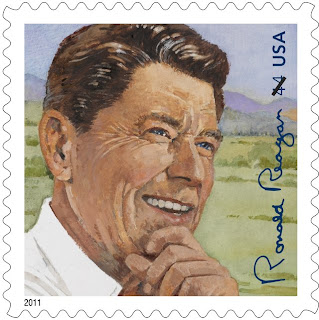
I ran out of my normal "Forever" stamps the other day, and so I bought instead four sheaves of the new Reagan stamp, largely because it would multivocally tickle my liberal and my conservative friends. On the reverse of each set is a potted biography of Reagan, which credits him with "bolstering the conservative movement" and "moving it from the margins to the mainstream of politics and government." In a very neat bit of wordsmithing, the author(s) avoid the touchy subject of Reagan's failure to best the establishment in 1968 and 1976:
Reagan launched his political career in a nationally televised address in 1964 endorsing the conservative Republican presidential candidate Barry Goldwater. He later served as governor of California and became a candidate for President. In 1980, Reagan defeated the incumbent President Jimmy Carter in the general election and was sworn into office on January 20, 1981.Because it's a beautiful day and I have better things to do, I won't even point out the abuse of the appositive (it should be "the incumbent president, Jimmy Carter," of course).
What's really astonishing, though, is the next paragraph, which contains this deathless bit of prose: "In his Inaugural Address, he declared, 'Government is not the solution to our problem; government is the problem.'" And here we have the irony of contemporary conservative discourse in a nutshell: This is a sentence printed by a government agency (no, the USPS is not a private corporation) that decries the necessity of government while appropriating the power of the state for commemorative and partisan ends.
Well done. Insincere government-hating requires an impressive amount of cognitive dissonance, but the right has squared the circle.
Subscribe to:
Posts (Atom)